
The science of light

How light sets your body clock

Light is the strongest signal your body clock has. Bright light in the morning tells it the day has begun, and gentler light in the evening lets it wind down. Here is what the research says, and how Halo puts it to work with daylight-white light for mornings and 660nm red light for evenings.

  • Free UK delivery
  • 30-night home trial

The winter blues

Why winter mornings feel so hard

On the shortest day, London gets less than half the daylight of midsummer, and much of it arrives while most of us are indoors. Fewer bright mornings means a weaker signal to your body clock.

Using a bright light to stand in for daylight, often called light therapy, is something many people turn to in the darker months, and researchers have studied it for winter low mood since the 1980s. Halo brings that bright morning light into a wearable, so you are not tied to a box on the table.

Daylight in London

  • 21 Juneabout 16h 38m
  • 21 Decemberabout 7h 49m

How bright is bright?

  • Typical room lightingaround 200 lux
  • Overcast winter dayaround 1,000 lux
  • Light therapy box10,000 lux at the set distance
  • Bright summer sunup to 100,000 lux

Typical, rounded values on a log scale. Light levels vary with weather, distance and direction.

Your body clock

Your body runs on a 24-hour clock

Every cell in your body follows a roughly 24-hour rhythm, kept in time by a master clock in your brain. Its main messenger at night is melatonin, the hormone that makes you feel sleepy.

Melatonin stays low through the day, rises in the late evening and peaks in the early hours. Light is what keeps that rhythm on time: bright light in the morning switches it off, while bright light late in the evening can push it back.

DAYTIMENIGHT 06:0009:0012:0015:0018:0021:0000:0003:0006:00 07:00 · Halo white lightswitches melatonin off and sets the day 21:30 · Halo red lighta gentler light while melatonin rises Melatonin peaksMelatonin on a typical nightAfter bright room light in the evening: later, and around 90 minutes shorter* DAYTIME 06:0012:0018:0000:0006:00 07:00 · white light 21:30 · red light Melatonin peaks
  • Melatonin on a typical night
  • After bright room light in the evening: later, and around 90 minutes shorter*

*Gooley et al. 2011: 116 healthy adults. Compared with dim light, ordinary room light before bed delayed the rise of melatonin in 99% of people and shortened its night-time release by around 90 minutes. Curves are illustrative.

What morning light does

From your eyes to your body clock

Five steps, from morning light reaching your eyes to a body clock that is set for the day. Tap any step.

IN THE BRAIN HALO LIGHT MELANOPSIN CELLS (ipRGCs) CORNEA LENS RETINA OPTIC NERVE MASTER CLOCK (SCN) PINEAL GLAND DAY STARTS
  1. Halo's light bar sits at your brow and shines bright light towards your eyes. It passes through the cornea and lens and lands on the retina at the back of the eye.

Two kinds of light

Why white in the morning, and red at night

The cells that set your body clock do not see colour the way you do. They respond most to blue-green light, and barely at all to deep red. That is why Halo uses two different lights.

Most potent: 446 to 477nm 400nm450nm500nm550nm600nm650nm700nm Halo daylight whitebroad, bright light, blue-green included Halo red light: 660nmwhere these cells barely respondHow strongly the body clock responds Most potent: 446 to 477nm 400nm500nm600nm700nm Halo daylight white Halo red: 660nm

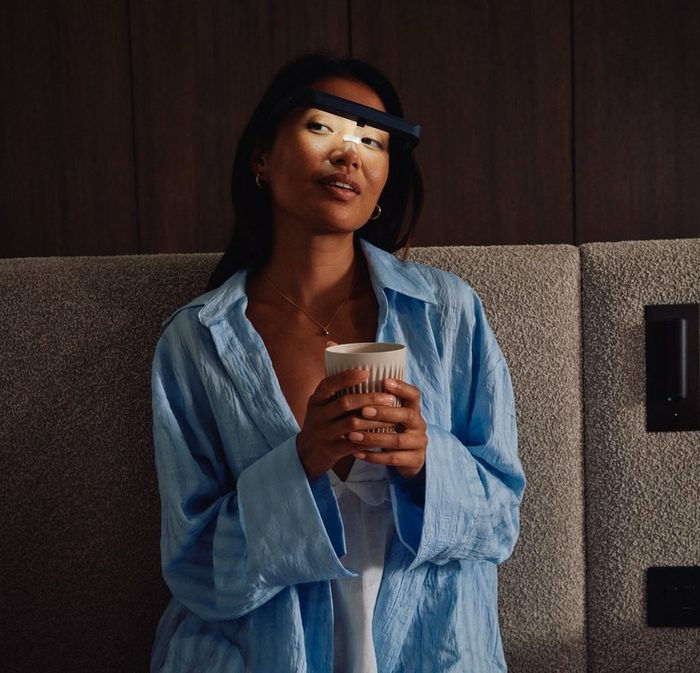
In the morning, you want the signal. Halo’s daylight-white light is bright and broad, including the blue-green wavelengths these cells respond to, so your body clock gets a clear message that the day has started.

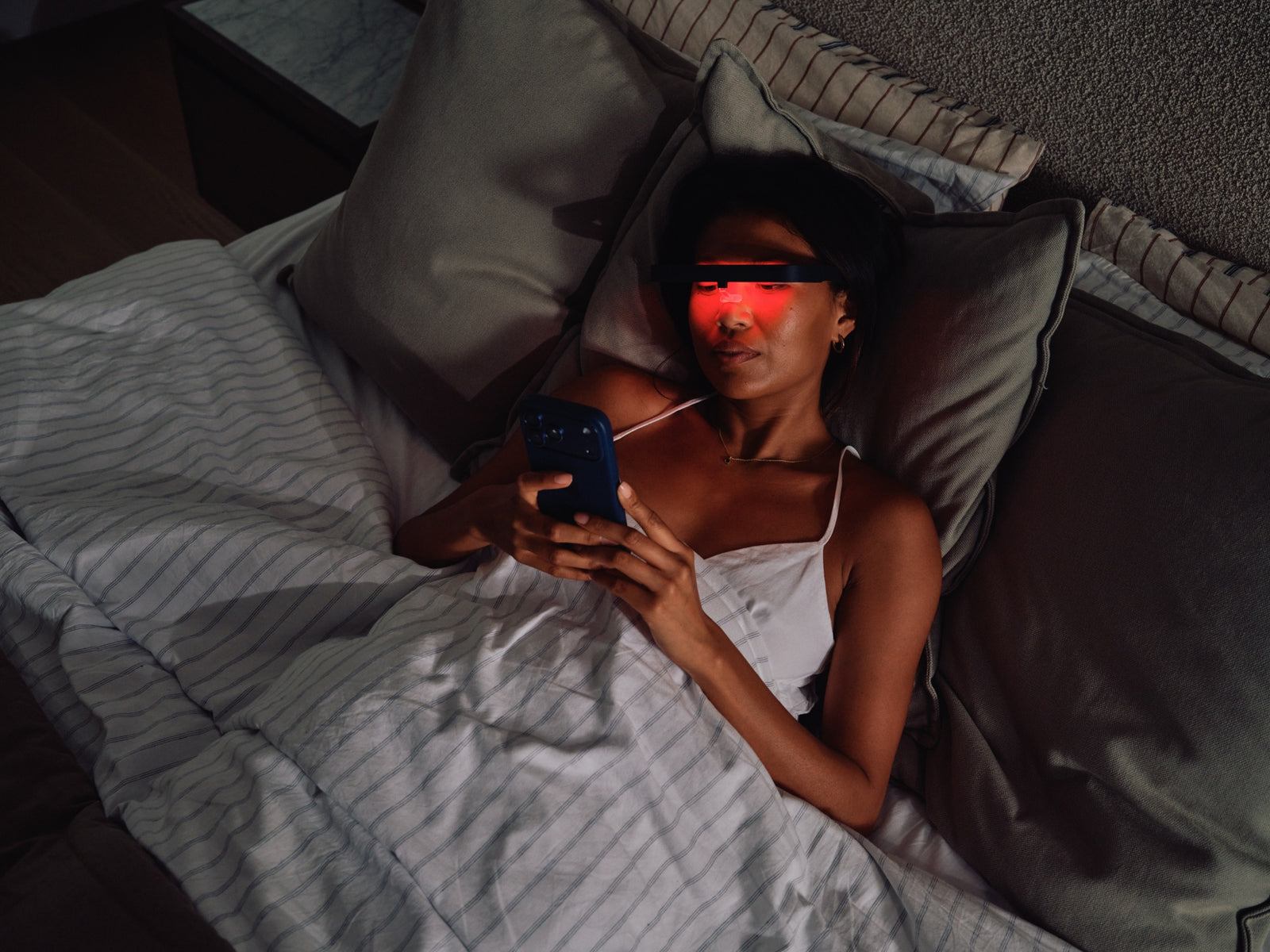
In the evening, you want light without the signal. Halo’s red light sits at 660nm, far from the 446 to 477nm range that is most potent at holding back melatonin. It gives you a warm light to read or relax by as your body gets ready for sleep.

Sensitivity curve drawn from Brainard et al. 2001, who found 446 to 477nm the most potent at suppressing melatonin (627 tests, 72 volunteers). Illustrative.

Meet Halo

Two lights. One wearable.

Halo combines daylight-white light for your mornings with 660nm red light for your evenings, in a lightweight frame you can wear while you get on with your day.

Shop Halo
  • Daylight-white light

    Bright, broad white light for your mornings, close to your eyes and completely hands-free.

  • 660nm red light

    A warm, gentle light for your evenings, far from the blue-green light that tells your body it is daytime.

  • Fits around your routine

    Have breakfast, answer emails or get ready. Halo works while you do.

  • Lightweight comfort

    Designed for everyday wear, and it sits comfortably over most prescription glasses.

Why Halo

Brighter mornings. Calmer evenings.

Two simple sessions a day, built around what you already do.

  • MORNINGS

    Wake up feeling brighter

    15minutes of daylight-white light

    Wear Halo while you get ready, have breakfast or check your emails, and give your body clock a clear start to the day.

  • EVENINGS

    Wind down without bright light

    660nm warm red light

    Switch to red as the evening draws in and let your body get ready for sleep.

  • ROUTINE

    Sleepy at the right time

    2sessions a day, morning and evening

    A steady morning signal helps keep your body clock on time, so evenings feel easier to wind down.

  • WINTER

    Brighter winter mornings

    7h 49mof daylight in London on the shortest day

    When the days are short, Halo brings bright light to your morning, whatever the weather.

  • HANDS-FREE

    No light box. No sitting still.

    Read, work or have breakfast while Halo does its thing. Your routine stays exactly as it is.

    • Fits over most glasses
    • USB-C rechargeable
    • Lightweight, everyday design

How it compares

Light therapy, without the light box

A traditional light box sits on a table and asks you to sit in front of it. Halo puts the light at your eyes and lets you move, with a second, red light for your evenings.

  • 2light modes: daylight white and 660nm red
  • 15mina session, hands-free
  • 660nmred light for your evenings
  • USB-Crechargeable, made to travel
Halo compared with a traditional light box
FeatureHaloTraditional light box
Hands-free and wearableYesNo
Use it while you work, read or get readyYesLimited
Bright white light for morningsYesYes
Red light mode for eveningsYesNo
Light close to your eyesYesSits on a table
PortableYesLimited

The evidence

Over 40 years of research into light, sleep and mood.

Light therapy was first described for winter depression, known as seasonal affective disorder (SAD), in 1984.

Since then, researchers have published thousands of papers on how light shapes our sleep, our mood and the body clock that runs them.

Papers on light therapy for sleep, mood and the body clock, per year
Papers on light therapy for sleep, mood and the body clock published each year on PubMed, rising from 7 in 1984 to 190 in 2025.501001501984: 7 papers1985: 11 papers19851986: 19 papers1987: 21 papers1988: 29 papers1989: 35 papers1990: 43 papers1991: 52 papers1992: 43 papers1993: 57 papers1994: 52 papers1995: 65 papers19951996: 52 papers1997: 76 papers1998: 81 papers1999: 74 papers2000: 55 papers2001: 60 papers2002: 53 papers2003: 59 papers2004: 49 papers2005: 81 papers20052006: 64 papers2007: 85 papers2008: 63 papers2009: 77 papers2010: 70 papers2011: 70 papers2012: 93 papers2013: 90 papers2014: 107 papers2015: 115 papers20152016: 106 papers2017: 118 papers2018: 117 papers2019: 121 papers2020: 124 papers2021: 146 papers2022: 165 papers2023: 162 papers2024: 159 papers2025: 190 papers2025190 papers in 2025
  • 3,200+papers on light therapy for sleep, mood and the body clock, listed on PubMed
  • 1984the year light therapy for seasonal affective disorder was first described
  • 500+studies on light therapy for seasonal affective disorder
  • 446 to 477nmthe blue-green light the body clock responds to most

Source: PubMed searches, October 2026.

What the evidence says

What the research says

Summaries of the studies behind this page, on light, mood, melatonin and sleep. Each links to the study on PubMed.

GROWING EVIDENCEMood

Winter low mood

Seasonal affective disorder

8 trialsRandomised, controlled

A review of randomised controlled trials found that bright light treatment significantly reduced the symptoms of seasonal affective disorder.

Golden et al. American Journal of Psychiatry, 2005
WELL ESTABLISHEDMelatoninSleep timing

Evening light and melatonin

Healthy adults

116 peopleLiving in a sleep lab

Ordinary room light before bed delayed the evening rise of melatonin in 99% of people and shortened its night-time release by around 90 minutes, compared with dim light.

Gooley et al. Journal of Clinical Endocrinology and Metabolism, 2011
WELL ESTABLISHEDMelatoninWavelength

Which light sets the clock

Healthy adults

627 tests72 volunteers

Light between 446 and 477nm, blue-green, was the most potent at suppressing melatonin, pointing to a dedicated light sensor for the body clock.

Brainard et al. Journal of Neuroscience, 2001
PROMISINGSleep qualityMelatonin

Red light and sleep

Elite athletes

20 athletes14 nights

30 minutes of red light each night for 14 days improved sleep quality and melatonin levels compared with a group who had no light.

Zhao et al. Journal of Athletic Training, 2012

The studies use different light sources, brightness, timings and people. They did not test Halo itself, but help explain the science behind morning and evening light.

Halo

Switch on your mornings. Switch off at night.

Halo brings daylight-white light to your mornings and 660nm red light to your evenings, hands-free.

£199.99

  • Daylight-white lightBright, broad light for your mornings.
  • 660nm red lightA gentler light for your evenings.
  • Hands-free and wearableFits over most glasses, so you can carry on with your day.
  • USB-C rechargeableLightweight and easy to take with you.
Pre-order Halo

Dispatch from 26 October

  • Free UK delivery
  • 30-night home trial

FAQ

Your questions, answered

Need help choosing? Our UK team is happy to talk it through.

Get in touch
Is Halo a treatment for SAD?
No. Halo is a wellness product designed to bring bright light into your morning and a gentler red light into your evening. It is not a medical device and is not intended to diagnose, treat or prevent seasonal affective disorder or any other condition. If you are struggling with low mood, please speak to your GP.
When should I use it?
Use the daylight-white light in the morning, ideally around the same time each day, while you get ready, have breakfast or start work. Switch to the 660nm red light in the evening as part of your wind-down.
How long is a session?
Most people use Halo for around 15 minutes at a time. It is hands-free, so it fits around whatever you are already doing.
Why red light in the evening?
The cells that set your body clock respond most strongly to blue-green light and barely at all to deep red. Bright white light late in the evening can delay your body’s evening rise in melatonin. 660nm red light gives you light to see by without that bright white signal.
Can I wear it with glasses?
Yes. Halo is designed to sit comfortably over most prescription frames.
What if it is not for me?
Try Halo at home. If it is not right for you, send it back for a full refund.

Halo is a wellness product. It is not intended to diagnose, treat, cure or prevent any disease, including seasonal affective disorder. If you are struggling with low mood, speak to your GP.